


'Can we just skip the structured cabling and run everything wireless?' is the most-asked question Azizi Technologies engineers get during Dubai office network planning. The short answer: technically yes since Wi-Fi 6E and Wi-Fi 7, but the long answer depends on four factors that drive a clear decision. Here's the honest 2026 framework for picking between structured cabling, wireless-only, or the hybrid most offices actually need.
Factor 1: How much bandwidth do concurrent users actually get?
Shared across 50 concurrent users, even Wi-Fi 7 delivers roughly 40-60 Mbps per person - barely enough for one HD video call each. Wi-Fi 7 on the 6 GHz band can deliver 2-3 Gbps real-world to a single client, which sounds like plenty until you multiply by IoT, cloud backup, file transfer and sync traffic running behind every desk. For offices past 25 staff, the wired backbone always handles aggregate bandwidth better than wireless. Wired ethernet to each desk plus WiFi for mobility is the standard pattern.
The AP-count math nobody shows you
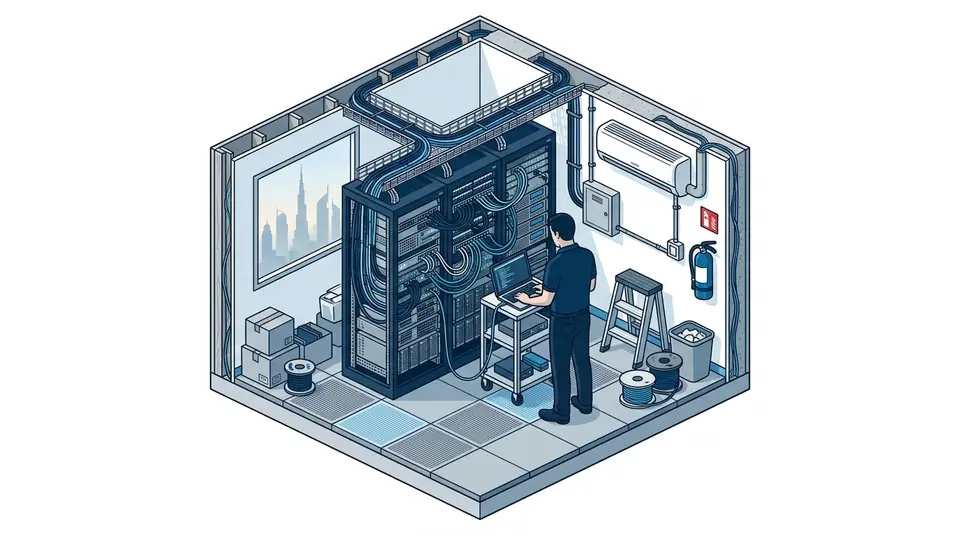
A 'wireless-only' 50-user office in Dubai still needs 5-7 enterprise APs - one per 120-150 m2 of open plan, plus extras for meeting rooms and dense zones - and every one of those APs needs a Cat6a home run back to the comms room and a PoE switch port. So wireless-only never means zero cabling; it means 5-7 cable runs instead of 50-60. That distinction matters when you compare quotes: you are saving on desk drops, not on the cabling trade entirely.
Factor 2: Which traffic still demands a cable?
VoIP phones, live video editing, financial trading terminals and CAD workstations should always be wired - everything else can roam. Wired ethernet is dramatically more reliable than WiFi: no interference, no roaming gaps, sub-1ms latency, deterministic behaviour. WiFi is acceptable for laptops, phones, and casual desktop use. Most Dubai offices need both: wired for the latency-sensitive workflows, wireless for everything else.
Dubai tower interference is the hidden tax on wireless-only
On site surveys in JLT, Business Bay and Dubai Media City towers we routinely log 25-40 neighbouring SSIDs on 2.4 GHz and 15+ on 5 GHz. That congestion shows up as VoIP jitter and frozen Zoom screens at 2pm - never in the sales demo. A cabled desk is immune to all of it.
Factor 3: Which costs less over 10 years?
Structured cabling costs more to build and less to own. For a 40-desk Dubai office, cabling every desk (Cat 6a, racks, Fluke certification) costs more up front than wireless-only (no desk cabling, just APs and a PoE switch for the APs). But over 10 years: wired cabling lasts 15-20 years untouched, wireless APs need refresh every 5-7 years (Wi-Fi 5 to 6 to 6E to 7). Add the two AP refreshes a wireless-only office needs for new WiFi standards, and cabling usually wins over the life of the lease.
What does structured cabling actually cost per point in Dubai?
Cabling is priced per point in Dubai, supplied, installed, terminated and tested, and Cat6a points cost more than Cat6. A 'point' covers the full channel: faceplate and keystone at the desk, the cable run through the ceiling void and containment, patch-panel termination in the rack, labelling, and a test result. A 40-desk office with two points per desk plus APs, CCTV and printers lands around 95-110 points - which is how the project quote builds up. Five things move the per-point price:
- Ceiling type: open-grid false ceilings keep costs at the low end; closed gypsum ceilings need access panels and add to the per-point cost
- Distance to the comms room: runs approaching the 90 m channel limit can force an extra IDF cabinet
- After-hours rules: occupied towers in DIFC and Downtown often mandate night or weekend works, which adds to labour
- Certification: Fluke DSX channel testing with printed reports adds a little per point and is worth it the day a warranty claim arises
- Containment: sharing existing cable tray is cheap; new dedicated basket costs more upfront but prevents future rip-outs
Factor 4: What about 10G uplinks and PoE devices?
Dubai offices are increasingly adding 10G uplinks (video editing suites, server room connections), PoE+ ceiling lighting, IoT sensors, IP CCTV cameras, VoIP phones, badge readers. All of these are wired by design and are not getting replaced with wireless equivalents. Cat 6a structured cabling supports 10G to every endpoint plus full PoE++ (90W) - covers every realistic 2026-2036 device. Going wireless-only locks you out of these future device categories.
Cat6, Cat6a or fibre: which cable should you actually pull?
Pull Cat6a to desks and AP positions, and OM3 or OM4 fibre between floors - that combination covers a Dubai office for 15+ years. Cat6 still makes sense on cost-sensitive fit-outs: it carries 1G at any office distance and 10G up to 55 m, which covers most single-floor layouts. Cat6a guarantees 10G at the full 90 m channel and handles PoE++ heat better in bundled ceiling runs. Fibre is for riser links between comms rooms, runs past 90 m, and anything crossing electrically noisy plant areas.
| Cable | Speed and distance | Best for |
|---|---|---|
| Cat6 | 1G at 90 m; 10G to 55 m | Desks, VoIP, CCTV in smaller offices |
| Cat6a | 10G at full 90 m; best PoE++ thermals | Desks, Wi-Fi 6E/7 APs, 10-year builds |
| OM3/OM4 fibre | 10-40G at 300 m+ | Risers, server room links, inter-floor backbone |
Cable choice for Dubai office fit-outs (2026)
| Factor | Structured Cabling | Wireless-only |
|---|---|---|
| Build cost (40 desks) | Higher up front: cable runs, patch panels and a rack | Lower up front: APs and a PoE switch |
| 10-year TCO | Lower: cable lasts 15-20 years, minor maintenance | Higher: APs refreshed every 5-7 years |
| Bandwidth per desk | 1G or 10G dedicated | Shared across all clients |
| Latency | Sub-1ms | 10-30ms typical |
| VoIP / trading desks | Yes (recommended) | Acceptable with QoS |
| 10G uplinks possible | Yes (Cat 6a) | Limited |
| PoE devices supported | Yes (lighting, IP cameras) | Only at AP locations |
| Hardware lifespan | 15-20 years | 5-7 years per AP refresh |
Structured cabling vs wireless-only - Dubai office 2026
How do Dubai fit-out rules change the cabling decision?
In most Dubai towers you cannot legally pull cable without a fit-out permit, and that paperwork - not the cabling itself - sets your timeline. In DMCC (JLT), Dubai Media City and similar free zones, expect 1-3 weeks for fit-out approval covering low-voltage works, plus a landlord NOC and sometimes a building-management supervision fee. Data cabling is low-voltage, so DEWA approval is not normally required - the real gatekeepers are the free zone authority and building management. The practical consequence: cabling is cheap and fast while the false ceiling is open during fit-out, and slow and expensive once the office is occupied and finished. Decide your cabling scope before the contractor closes the ceiling, not after.
The cheapest week to cable an office
It is the week the ceiling grid is open and the fit-out permit is already live. Retrofitting the same points into a finished, occupied office costs far more and usually happens at night. If you are mid fit-out in JLT, Business Bay or Media City, lock the cabling design this week, not at handover.
Mid fit-out and need a cabling design fast?
Azizi Technologies produces point schedules, containment routes and free zone-ready low-voltage drawings, then installs and Fluke-certifies the lot. Site surveys come before the quote.

When is wireless-only the right call?
Wireless-only makes sense in three Dubai office scenarios. (1) Coworking and serviced offices where tenant churn is high and structured cabling per-desk would be permanent infrastructure rented to short-term occupants. (2) Pop-up retail or temporary fit-outs (events, exhibitions, seasonal stores) where the office lives 6-18 months. (3) Strict cloud-only operations with no on-prem servers, no VoIP phones, no IP CCTV, no PoE lighting - rare in Dubai but real. For everyone else, the hybrid (wired backbone plus wireless for mobility) is the right call.
The hybrid that most Dubai offices actually deploy
Standard 2026 Dubai SMB office network from Azizi Technologies: Cat 6a structured cabling to every desk and to every AP location, plus an enterprise WiFi mesh broadcasting on top. Staff connect their docked workstations and VoIP phones via ethernet (full speed, dedicated bandwidth, low latency), and connect laptops and phones via WiFi for mobility around the office. This hybrid handles every realistic workload, costs more than wireless-only at install, and lasts far longer.
Don't forget the PoE budget
Six Wi-Fi 7 APs (Ubiquiti U7 Pro at 21-25W each) plus eight IP cameras and twenty VoIP phones can draw 350W or more. Spec the PoE switch by total power budget, not just port count, or APs will brown-out under load. A 48-port PoE+ switch with a 400-600W budget covers most 40-desk Dubai offices.
The compromise that gets called 'wireless office'
What most 'wireless office' marketing actually means in 2026 is: wireless to staff devices, but still wired uplinks between switches and APs, plus wired connections to printers, IP phones, server rooms and key infrastructure. True wireless-only (no ethernet anywhere) is rare and usually a mistake. Don't accept a quote that pretends to skip the cabling entirely - check if it's wired uplinks plus wireless to devices, which is the right answer.
Five questions that settle cabling vs wireless
- 1Will the office still be yours in 3+ years? If yes, cabling amortises easily; if you rent serviced space short-term, lean wireless.
- 2Do you run VoIP desk phones, IP CCTV, door access or on-prem servers? Any yes means structured cabling.
- 3Is headcount 25+ or heading there? Aggregate bandwidth will outgrow wireless-only within the lease.
- 4Is the false ceiling currently open (fit-out in progress)? Cable now while the ceiling is open, or pay far more to retrofit later.
- 5Does any workflow need sub-5ms latency (trading, video editing, large CAD files)? Wireless cannot guarantee it.
Score three or more 'yes' answers and the hybrid - structured cabling plus enterprise WiFi - is the right design for your office. Azizi Technologies quotes both options on every survey, so the comparison is concrete numbers for your floor plate, not theory.
"Every wireless-only office we get called in to rescue has the same story: the cabling budget saved at fit-out gets spent twice over on extra access points and after-hours retrofit work."
Dubai office cabling vs wireless quote
Send your office address, planned desk count, and any specific workload (VoIP, video editing, trading, etc.). We'll book a 60-minute site survey and email two quotes - one for structured cabling plus WiFi (recommended) and one for wireless-only - so you can compare directly.