

Extending WiFi coverage across a large Dubai office (500-2,000 m2) is one of the most-misunderstood IT projects SMBs take on. The instinct is to buy more consumer routers or range extenders - but the actual answer is enterprise-grade AP density, proper ethernet backhaul, and coordinated controller-managed RF design. Here's how Azizi Technologies handles WiFi coverage extension across Dubai offices in 2026, with real cost ranges.
Why is WiFi extension harder in Dubai office towers?
Dubai office towers stack three RF problems on top of normal office WiFi: concrete service cores that split each floor plate into separate radio zones, full-height glass partitions that reflect and leak 5 GHz, and dense clusters like JLT, DMCC and Media City where 40-80 neighbouring SSIDs are visible on every floor, all competing for the same channels. A design that works in a standalone Al Quoz warehouse fails on a DMCC floor plate of the same square meterage.
- JLT / DMCC high-rise: 40-80 visible neighbouring networks per floor make channel planning mandatory
- Media City / Internet City low-rise: deep 1,500-2,000 m2 floor plates with core shadows in the far corners
- Suspended ceilings: an AP hidden above the tiles loses 3-6 dB - mount on or below the ceiling line
- Glass meeting rooms leak and reflect signal - an in-room AP beats corridor spill for video calls
Why range extenders fail in large offices
Range extenders (TP-Link RE-series, Netgear EX-series, generic 'WiFi repeaters') halve usable bandwidth because every packet is transmitted twice - once from the router to the extender, once from the extender to the device. Roaming is broken: devices stick to the extender even after walking past the main router. In a 500+ m2 office with 30+ staff, range extenders create more problems than they solve. Throw them out, replace with proper enterprise APs.
Red flag in any quote
If a proposal for a 500 m2 office includes 'WiFi repeaters' or 'signal boosters', get a second opinion. Repeaters are a consumer workaround - at office scale they halve throughput, break roaming, and get ripped out within a year.
AP density rule of thumb
Standard density Azizi Technologies plans for Dubai offices: 1 AP per 25-30 staff in open-plan, 1 AP per 15-20 staff in partition-heavy or hotelling space, 1 AP per 100-150 m2 of open floor in client-facing areas (lobby, reception), 1 dedicated AP per meeting room of 8+ seats (handles all simultaneous Zoom/Teams calls). A 1,000 m2 office of 50 staff plus 4 meeting rooms typically needs 7-10 APs.
Ethernet backhaul over wireless mesh
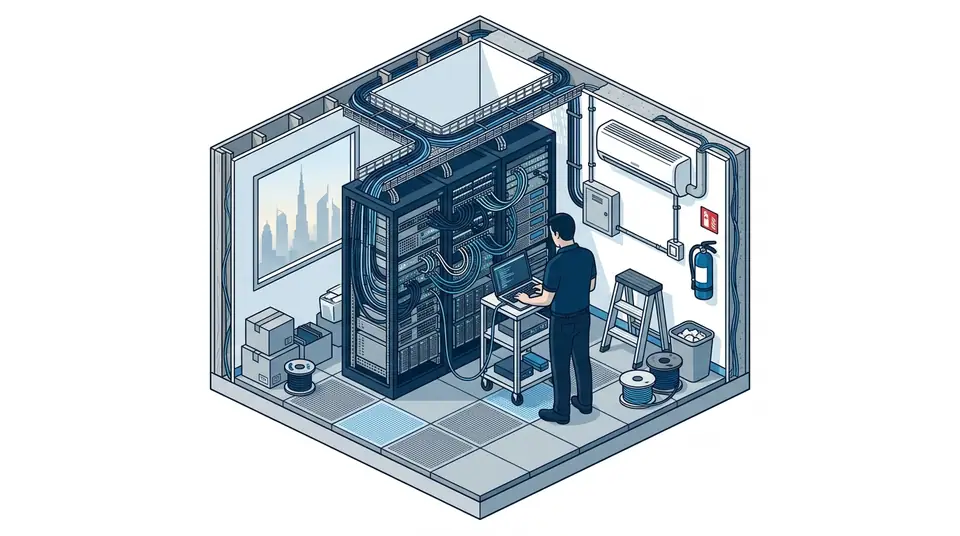
Run Cat 6 or Cat 6a from each AP location back to a central PoE switch in the server room. Wireless mesh backhaul is acceptable in homes but cripples large offices - when traffic crosses 2+ mesh hops, throughput falls sharply and latency spikes. Standard Azizi Technologies office install runs ethernet during the structured cabling phase, BEFORE installing APs. Each drop is priced on run length, ceiling access and whether the building insists on LSZH cable.
Ceiling voids have rules
Cable runs above suspended ceilings in Dubai towers usually pass through the AC return plenum - specify fire-rated (LSZH/plenum) jackets and book building management approval before the crew arrives. Skipping this is the most common cause of a one-week project slipping to three.
Choosing enterprise APs by office size
Small office (25-50 staff, 500 m2): Ubiquiti U6 Pro or TP-Link Omada EAP670, AED 800-900 per AP. Mid-office (50-150 staff, 1,000-1,500 m2): Cisco Meraki MR36 or Aruba Instant On AP25, AED 1,800-2,500 per AP. Enterprise (150-500 staff, 1,500-3,000+ m2): Cisco Meraki MR46-E or MR56, Aruba AP-635 or AP-655, Ubiquiti U7 Pro, AED 3,500-5,500 per AP. Higher tier APs handle more concurrent clients per AP, so you need fewer total APs - sometimes cheaper in 100+ user offices.
| Office Size | Staff | APs Needed |
|---|---|---|
| 500 m2 | 25-40 | 5-7 APs |
| 1,000 m2 | 50-80 | 8-12 APs |
| 1,500 m2 | 80-150 | 12-18 APs |
| 2,000 m2 | 150-250 | 18-25 APs |
| 3,000 m2+ | 250-500 | 25-40 APs |
AP counts for large Dubai offices (2026)
What switch and PoE budget does the extension need?
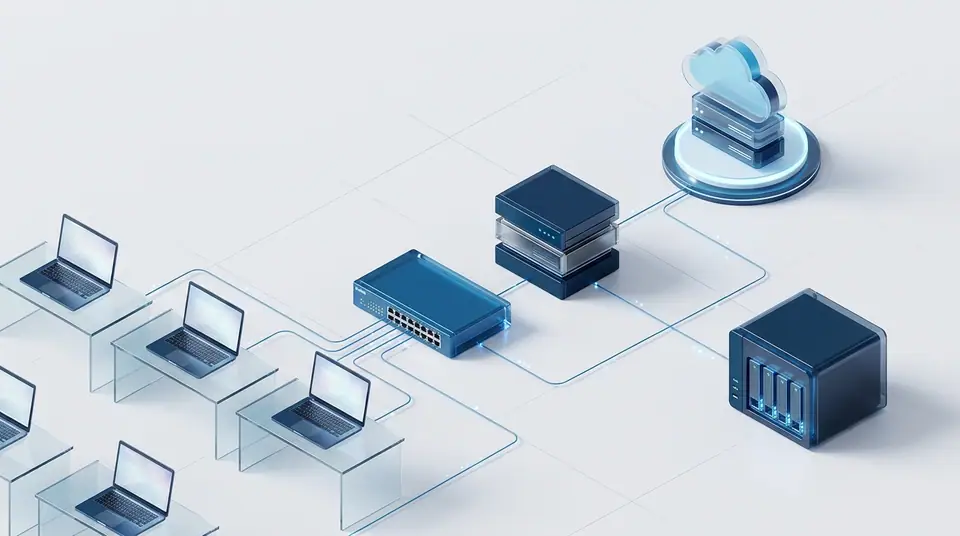
Every new AP needs a PoE switch port: a UniFi U6 Pro draws about 13 W, an Omada EAP670 about 20 W and a Meraki MR36 about 18 W, so ten new APs need 150-200 W of PoE budget once you add 30 percent headroom. Typical kit: UniFi USW-24-PoE 95 W (around AED 1,600) for small extensions, USW-Pro-24-PoE 400 W (around AED 2,900) for full floors. Going Wi-Fi 7 with U7 Pro or Meraki MR57? Specify 2.5 GbE ports, or the new APs bottleneck at the switch.
Buy PoE headroom once
Size the PoE budget for the AP count you will have in three years, not today. A 400 W switch over a 95 W one is a few hundred dirhams now; replacing an underpowered switch later means re-patching the whole rack out of hours.
How do you know where the new APs go?
AP positions come from a survey, not guesswork: a predictive RF design drawn over your floor plan, then an on-site heatmap walk to validate it, targeting -65 dBm or better on 5 GHz at every desk and -67 dBm inside meeting rooms. The survey also measures what your neighbours are doing - in a JLT tower the empty channels matter more than the AP brand. Azizi Technologies runs this survey for Dubai offices, including the heatmap and a written AP layout, before any quote.
Should you extend the existing WiFi or replace it?
Extend when the current APs are enterprise-grade, Wi-Fi 6 or newer, and all one vendor; replace when you are mixing consumer routers, the APs are five-plus years old, or the controller is end-of-life. Mixing vendors on one floor breaks fast roaming (802.11r) and splits management across two dashboards - the hardware saving is paid back in helpdesk tickets within months.
- Extend: same-vendor Wi-Fi 6 APs, healthy controller, just coverage gaps - add 3-5 APs and re-tune
- Replace: consumer mesh or repeaters anywhere in the chain, or APs older than five years
- Replace: out-of-support controller, or a licence model you want to exit (e.g. moving off per-AP fees)
- Either way: re-run the RF tune after adding APs - more radios at full power makes WiFi worse, not better
Controller-driven RF management
Once you have 5+ APs, manual channel and power tuning is impractical. Use a controller (UniFi Network for Ubiquiti, Meraki Dashboard for Cisco, Aruba Central for HPE, Omada Controller for TP-Link) to run continuous RF auto-tune. The controller measures channel utilisation, noise floor, and client distribution in real time, then adjusts AP channel selection and transmit power. In dense Dubai office buildings this is the difference between usable WiFi and constant interference.
Band steering and 6 GHz expansion
Enable band steering so newer devices auto-select 5 GHz or 6 GHz (Wi-Fi 6E and Wi-Fi 7) instead of jamming themselves onto the crowded 2.4 GHz band. 6 GHz is largely empty in Dubai office towers in 2026 - if you have any Wi-Fi 6E or 7 capable APs, push your phones, laptops and meeting room devices to 6 GHz aggressively. Old IoT (smart TVs, badge readers, projectors from 2018) stays on 2.4 GHz on a separate SSID/VLAN.
6 GHz needs tighter spacing
6 GHz gives clean, fast channels but penetrates partitions worse than 5 GHz. If you deploy Wi-Fi 6E or 7 APs to use it, plan roughly 20-30 percent more APs - or accept that 6 GHz serves the open areas while 5 GHz fills the corners.
VLAN segmentation across the larger network
Once your office gets past 50 staff, VLAN segmentation becomes mandatory. Staff VLAN, guest VLAN, IoT VLAN, server VLAN, BYOD VLAN - each broadcast as separate SSIDs from every AP. Compromised guest devices or printers cannot reach internal file shares. Critical for DIFC and ADGM offices; recommended for everyone. Done via SSID-to-VLAN binding in the controller; no extra hardware required beyond the firewall enforcing inter-VLAN rules.
Cutover and handover
Office WiFi extension cutover is scheduled outside business hours - typically Saturday morning or evening - with a 24-hour parallel-run period where both old and new networks broadcast different SSIDs. Staff devices auto-migrate to the new SSID over Monday morning; any device stuck on the old network gets manually configured. After 7 days the old hardware is removed. Full client documentation and 30 days post-cutover support included.
What does the extension project look like start to finish?
For a typical 1,000 m2 Dubai office adding or refreshing 8-12 APs, the project runs about two weeks end to end:
- 1Day 1: site survey - heatmap walk, neighbour channel scan, floor plan markup
- 2Day 2-3: predictive design and itemised quote (AP count, cable drops, switch, licences)
- 3Day 4-8: structured cabling crew runs Cat6a drops out of hours, Fluke-certifies every run
- 4Day 9-10: APs mounted and adopted to the controller, new SSIDs broadcast in parallel
- 5Day 11-12: RF auto-tune settles, heatmap re-validated against the design targets
- 6Weekend: cutover - old SSIDs retired, stragglers migrated manually on Monday morning
- 7Day 14 onward: 30-day hypercare, then handover documentation and optional AMC
What keeps the network fast after handover?
Ongoing management - controller monitoring, firmware updates in maintenance windows and a quarterly RF re-tune - is what stops a freshly extended network degrading as the offices around it change. A WiFi AMC covering monitoring, updates and fault response with defined SLAs is priced on AP count and the response terms you pick, so a 15-AP floor costs more to cover than a five-AP suite. Without a contract, book an annual health check at minimum: Dubai towers change tenants constantly, and yesterday's clean channel is next quarter's interference.
"The most common large-office mistake we see is adding access points without re-running the RF tune - twelve APs at full transmit power interfere with each other worse than eight tuned ones ever did."
Dubai large-office WiFi survey
Send your office address and rough square metres - we'll book a 60-minute site survey, run a signal heatmap, design an optimal AP layout, and email an itemised quote after the survey.