
Enterprise WiFi vs home WiFi is one of the most-misunderstood IT decisions Dubai businesses make. Most start with consumer routers (Eero, Asus AiMesh, TP-Link Deco) and try to scale them into 30-person offices. They mostly work - until the day they don't. Here's the 10 concrete differences between enterprise and home WiFi, with the use cases where the upgrade pays back.
1. Concurrent client capacity: 40-80 devices vs 200-500+
Consumer routers (Eero Pro 6E, Netgear Orbi RBKE960, Asus AX6000) handle 40-80 simultaneous clients before degradation starts. Enterprise APs (Ubiquiti U6 Pro, Cisco Meraki MR46, Aruba AP-635) handle 200-500+ clients per AP with full throughput. For a 30-person office with phones, laptops, IoT and meeting room devices, you'll have 90-120 concurrent clients - well past what consumer kit handles cleanly.
2. Roaming: why calls drop when you walk (802.11k/v/r)
Enterprise APs implement IEEE 802.11k (neighbour reports), 802.11v (BSS transition management) and 802.11r (fast roaming). When you walk from one end of an office to the other, your phone or laptop hands off between APs in under 50 milliseconds with no lost packets. Consumer mesh systems do simplified roaming but typically take 200-500 ms, breaking VoIP calls and Zoom meetings on the move. Critical for any business with voice calls or video meetings.
The 10-minute roaming self-test
Start a continuous ping (or stay on a Teams call) and walk the full office. On consumer mesh you will see 200-500 ms spikes or dropped packets at each hand-off point; on enterprise APs with 802.11r the walk stays clean. Ten minutes, and you know exactly which class of WiFi you own.
3. VLAN segmentation: one flat network vs four firewalled zones
Enterprise APs broadcast multiple SSIDs on different VLANs - one for staff, one for guests, one for IoT (printers, badge readers, CCTV), one for BYOD. Each VLAN is firewalled separately, so a compromised IoT device cannot reach staff PCs. Consumer routers offer 'guest WiFi' but it's a single VLAN with no granular control. For DIFC, ADGM and any compliance-regulated office, proper VLAN segmentation is mandatory.
The 4-VLAN design most Dubai offices need
- VLAN 10 - Staff: corporate laptops and desktops, full access to file servers and printers
- VLAN 20 - Guest: internet-only, client isolation on, bandwidth-capped at 10-20 Mbps per device
- VLAN 30 - IoT and facilities: printers, CCTV, door access, smart TVs - blocked from reaching staff machines
- VLAN 40 - VoIP: desk phones with QoS priority so calls survive a busy Monday morning
4. PoE and central management: 50 APs from one dashboard
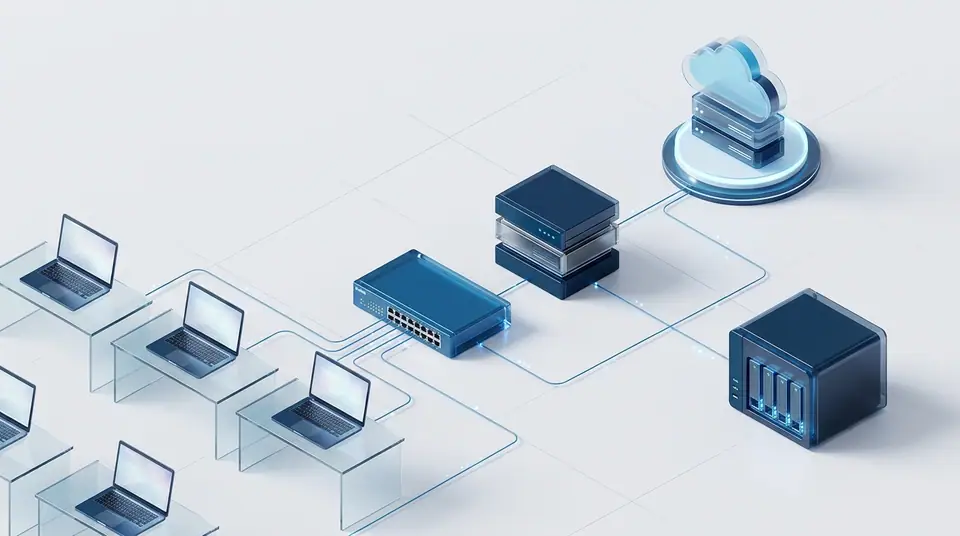
Enterprise APs are PoE-powered - no power outlet needed at the AP location, just a single ethernet cable carrying both data and power from a PoE switch. They're managed centrally from a controller (UniFi Network, Meraki Dashboard, Aruba Central) where one engineer can push config to 50 APs in 30 seconds. Consumer mesh systems each need their own power outlet and individual setup, which becomes painful past 4-5 APs.
5. Authentication: shared password vs 802.1X identity
Enterprise APs support 802.1X authentication tying each user to their identity (Active Directory, Azure AD, Google Workspace). When an employee leaves, you disable their AD account and they're locked out of WiFi instantly - no shared password rotation across 50 staff. Consumer routers only support shared WPA2/WPA3 passwords, which means rotating the password every time staff turn over.
| Feature | Consumer Mesh | Enterprise APs |
|---|---|---|
| Concurrent clients | 40-80 per node | 200-500+ per AP |
| Roaming speed | 200-500 ms | Under 50 ms (802.11r) |
| VLANs / SSIDs | 1-2 SSIDs, single VLAN | 8-16 SSIDs, full VLAN |
| Authentication | WPA2/WPA3 shared password | 802.1X + RADIUS / AD |
| Management | Per-node app | Central controller |
| PoE | No (needs power outlet) | Yes (single cable) |
| Compliance audit trail | No | Yes (Dashboard logs) |
| Hardware lifespan | 3-5 years | 7-10 years |
Consumer vs enterprise WiFi feature comparison (2026)
6. RF management: surviving a crowded Dubai tower
Enterprise controllers run continuous RF auto-tune - constantly measuring channel utilisation, noise floor, and client distribution, then adjusting AP power and channel selection in real time. In a dense Dubai office tower with 20+ neighbouring tenants on 2.4 GHz, this auto-tune keeps your network usable when ad-hoc consumer kit would degrade. Manual override is available for known interference sources.
7. Compliance audit trail: who connected, when, on what
DIFC banks, ADGM funds, MOHAP-regulated healthcare clinics and PCI DSS-scoped offices all need WiFi audit trails - who connected, when, from what device, to what SSID. Enterprise controllers (Meraki Dashboard, Aruba Central, UniFi Network) provide this automatically with 90-day retention. Consumer routers provide nothing. If you're in a regulated vertical in Dubai, enterprise WiFi is not optional.
8. Cost comparison
Consumer mesh for a 200 m2 Dubai office is roughly AED 1,500 to AED 2,500 of retail hardware. Enterprise WiFi for the same office (5 APs plus controller plus PoE switch) is roughly AED 8,000 to AED 15,000 of hardware before installation. The enterprise kit costs several times more up front, but it lasts 7-10 years against 3-5 years for consumer kit, so the 10-year cost moves much closer together. It also absorbs a lot more staff growth before it needs a refresh.
9. The Etisalat / du router: bridge mode beats double NAT
Whichever WiFi class you choose, the Etisalat or du router should hand traffic over in bridge mode - otherwise you run double NAT, which breaks VPNs, CCTV remote viewing and SIP desk phones in ways that are miserable to diagnose. Both ISPs enable bridge mode on business lines on request, or your installer configures the ONT-to-firewall handoff directly. One Dubai-specific caveat: if the office uses the ISP's IPTV service, keep the ISP router powered for the TV decoder and disable only its WiFi radios. Every enterprise install Azizi Technologies delivers includes this ISP handoff configuration - a 30-minute job that prevents months of 'the VPN keeps dropping' tickets.
Disable the ISP router's WiFi either way
Even on a consumer mesh, leaving the Etisalat/du router broadcasting its own SSID puts a competing network on overlapping channels inside your own office. Bridge it or switch its radios off - your real network gets cleaner spectrum instantly, for free.
10. Monitoring, support and the 9am Monday test
The real difference shows up when WiFi breaks at 9am on a Monday: consumer kit offers a power cycle and hope, enterprise WiFi offers remote diagnosis and a fix before lunch. Controllers stream live telemetry - per-client signal, retry rates, channel utilisation, switch port errors - so an engineer can pinpoint a failing AP or a flooded channel without setting foot on site. That telemetry is also what makes a support contract meaningful: Azizi Technologies runs WiFi AMC covering monitoring, firmware cycles, config changes and priority on-site response across Dubai. There is no equivalent for consumer mesh, because there is nothing to monitor remotely.
What does enterprise WiFi cost by Dubai office size?
As a 2026 rule of thumb, budgets scale roughly with floor area and staff count. The table assumes structured cabling already reaches the AP positions; new Cat6 points are quoted per point if it doesn't.
| Office size | Staff | APs |
|---|---|---|
| Up to 100 m2 | 5-10 | 1-2 |
| 200 m2 | 10-25 | 3-5 |
| 400 m2 | 25-50 | 5-8 |
| 800 m2+ | 50-120 | 8-14 |
Enterprise WiFi AP counts by office size (Dubai, 2026)
Want both numbers for your exact floor plan?
Send your office size and staff count - we'll survey free of charge and quote a UniFi-class and a Meraki-class design side by side, with AP placement drawings included.

How do you migrate from home WiFi to enterprise without downtime?
A clean migration runs the new network in parallel and cuts over in one quiet morning - staff arrive Monday to a new SSID and nothing else changes. The standard six-step sequence:
- 1Site survey and heatmap: confirm AP count and ceiling positions (about 60 minutes)
- 2Cabling check: existing Cat5e/Cat6 runs to ceiling positions get reused; missing runs quoted per point
- 3Stage the controller, PoE switch and APs off-site with VLANs, SSIDs and 802.1X pre-configured
- 4Install APs and switch after hours; run old and new networks in parallel for 1-3 days
- 5Cut over on a Saturday morning: move devices, repoint printers and CCTV, switch off the old mesh
- 6Decommission, then a 30-day hyper-care window for stragglers - smart TVs, badge readers, that one ancient printer
When is home-grade WiFi genuinely the right choice?
For Dubai villas, apartments and offices under 10 staff with no compliance requirements, consumer mesh is the right answer - enterprise gear would be money spent on features you would never switch on. A TP-Link Deco BE85 or Eero Pro 6E pair covers a 250-350 m2 villa with roughly AED 1,500 to AED 2,500 of retail hardware, and Azizi Technologies installs and optimises home WiFi including placement testing and ISP bridge-mode setup. The honest boundary: the day you add a file server, desk phones, CCTV you actually rely on, or your 11th employee, you have crossed into enterprise territory - budget the upgrade then, not before.
Where consumer mesh becomes a liability
If your office handles client funds, health records or card payments (DIFC, ADGM, MOHAP, PCI DSS scopes), consumer WiFi is an audit finding waiting to happen - no per-user authentication, no logs, no VLAN separation. The regulator will not care that the Eero worked fine.
"Half of our enterprise WiFi projects start as a support call about a consumer mesh that was fine at 8 staff and is drowning at 25. The hardware didn't get worse - the office outgrew it."
Where the breakpoint actually is
For Dubai offices under 10 staff in 100 m2 space, consumer mesh (Eero Pro 6E, TP-Link Deco XE75) is fine. From 10-25 staff, prosumer / SOHO enterprise (Ubiquiti UniFi - UDM Pro plus 2-3 U6 Pro APs) is the sweet spot. Above 25 staff, full enterprise (Cisco Meraki, Aruba InstantOn, full UniFi enterprise) is the right call.
Not sure if you need enterprise WiFi?
Send your office address, staff count, and current WiFi setup - we'll run a 60-minute site survey and give a written recommendation with a quote for both options (upgrade existing vs full enterprise rebuild).