

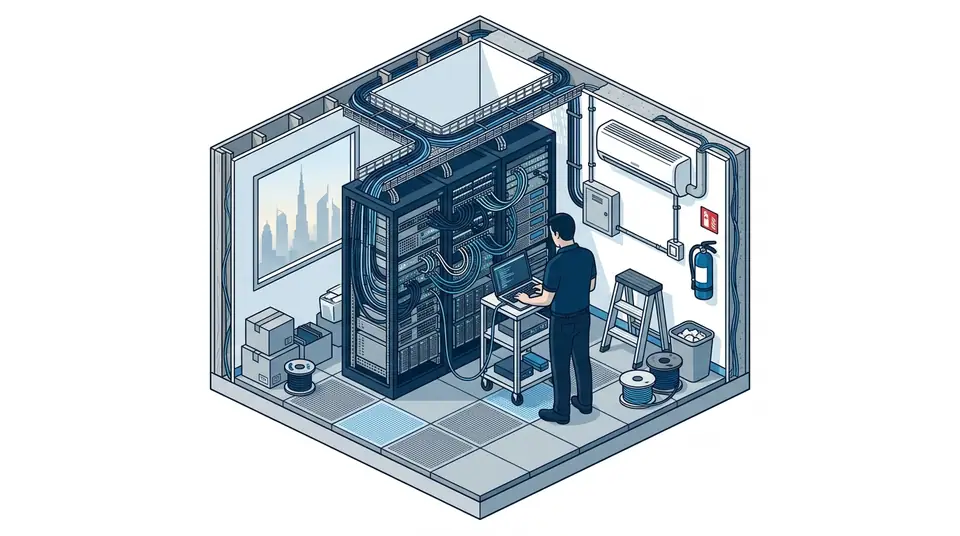


UAE guest WiFi - whether in hotels, cafes, restaurants, or shopping malls - is regulated by the TRA (now TDRA, the Telecommunications and Digital Government Regulatory Authority). Most hoteliers don't know the rules until an audit or a fine arrives. Here's what the regulation actually requires in 2026 and how to be compliant without ruining guest experience - including lawful intercept, liability, and holiday homes.
What's at stake
Non-compliance exposes the operator to penalties under the UAE telecommunications framework, plus licence-renewal friction with DET (Department of Economy and Tourism) if WiFi compliance is flagged during inspection. Specific fine amounts quoted online vary by violation and year; confirm current penalty schedules with TDRA before budgeting.
Who regulates hotel guest WiFi in the UAE?
The TDRA, the UAE's federal telecom regulator, sets the framework guest WiFi operates under: offering internet access to the public is a regulated activity. Three parties sit inside it: the licensed ISPs (e&/Etisalat and du), which hold the telecom licences and upstream lawful-intercept obligations; the venue operator, providing access under its trade licence and ISP contract; and in Dubai, DET/DTCM adds hospitality oversight through classification and holiday-home permits.
TRA or TDRA? Same regulator
The Telecommunications Regulatory Authority became the Telecommunications and Digital Government Regulatory Authority (TDRA) in 2021. Older ISP contracts and datasheets still say TRA; have your integrator confirm cited documents are current.
What are the TRA / TDRA core requirements in 2026?
- Identifiable guest authentication - guests must authenticate before accessing the internet. Anonymous open WiFi is not legal for hospitality / commercial use in the UAE.
- Identity verification on guest authentication - the captive portal must collect at minimum a verifiable phone number (via OTP/SMS verification) OR national ID linkage via TDRA-approved providers.
- Session logging - timestamps, MAC addresses, IP allocations, source/destination of traffic must be retained for 12 months minimum.
- Access logs accessible to authorities - if requested by law enforcement, logs must be retrievable within 48 hours.
- Acceptable Use Policy - a TDRA-aligned AUP must be presented to and accepted by every guest before access is granted.
- Content filtering - access to TDRA-blocked categories (VPNs, adult content, gambling) must be blocked at the network level.
- Bandwidth management - guest bandwidth must not interfere with business operations or POS / PMS systems.
What must a compliant captive portal include?
- Branded portal page with hotel name, terms of service, AUP, and authentication method clearly displayed.
- Phone number + SMS OTP is the most common compliance path - guests enter UAE or international mobile, receive OTP, authenticate.
- Hotel guests can be auto-authenticated via PMS integration (Opera, Cloudbeds, Mews) using room number + last name as the auth factor - reduces friction significantly.
- Repeat guests within retention period can be remembered (improving UX) as long as the original verification was valid.
- Multilingual portal mandatory - English + Arabic at minimum. Russian, Mandarin, Hindi strongly recommended for mid-to-upper-tier hotels.
What guest identity must the portal actually capture?
Every session must be attributable to a verified real-world identity - collecting a number without validating it fails the test. Three patterns satisfy it: SMS OTP to a mobile number (must accept non-UAE country codes or tourists are locked out), PMS-linked authentication inheriting the passport or Emirates ID captured at check-in, and Emirates ID validation for walk-in guests. Whatever you capture is personal data under the UAE Personal Data Protection Law: publish a privacy notice and keep marketing reuse behind a separate opt-in.
What lawful-intercept and data-retention duties apply?
Formal lawful-intercept capability sits with the licensed ISPs, but the chain only works if the venue can attribute a session to a person; that is what hotel-side logging exists for. The chain: law enforcement issues a lawful request, the ISP identifies the circuit and venue, and the venue produces session records that turn 'this hotel's IP address' into 'this guest'. The commonly applied floor in hospitality is 12 months of session logs, retrievable within 48 hours - confirm current figures with TDRA and your ISP.
What data must hotels retain - and what can't be used?
| Required | Retention | Allowed for hotel use |
|---|---|---|
| MAC address + IP allocation logs | 12 months | TDRA / law enforcement only |
| Session start/end timestamps | 12 months | TDRA / law enforcement only |
| Auth phone number / ID | 12 months | TDRA + hotel CRM (with consent) |
| Browsing history (URLs visited) | Not required to retain | Cannot be used for marketing |
| Marketing opt-in via portal | Per consent terms | Yes - separate explicit opt-in |
What hotels must retain vs cannot collect
Logs on the controller are not retention
Default WiFi controllers keep 30 to 60 days of events, then overwrite. Retention means logs exported to storage that survives controller replacement for 12 months. Confirm where logs live and who produces them on request.
Do you need a registered Etisalat / du hospitality internet plan?
Guest WiFi should run on a business service registered to the venue's trade licence - serving paying guests from a consumer plan breaches ISP terms and breaks the traceability chain. Both e&/Etisalat and du sell hospitality and business plans with static IPs and business SLAs. Confirm before signing: guest WiFi is permitted use on the plan (bundling free WiFi into the room rate is standard; charging separately for access needs explicit arrangement), and who provides the captive portal and logging - some bundles include them, otherwise an integrator such as Azizi Technologies builds them on your infrastructure.
How should bandwidth be shaped without hurting guest experience?
- Cap per-guest bandwidth to prevent abuse (one guest streaming 4K ruins the network for others).
- Typical caps: 5-10 Mbps per device for standard tier, 25-50 Mbps for premium / loyalty tier.
- Reserve dedicated bandwidth for PMS / POS / Opera systems - these are business-critical and must not share guest bandwidth.
- Conference rooms / meeting spaces need premium tier WiFi - typically a separate SSID with higher caps and priority QoS.
Who is liable - the hotel, the ISP, or the integrator?
The venue operator carries primary responsibility for guest WiFi compliance - liability follows the trade licence the service is offered under, not the brand on the access points. The ISP answers for its licensed network and upstream intercept capability, not for your portal, logs or filtering unless contracted as managed services. The integrator is contractually responsible for the controls - so install and AMC contracts should name them explicitly: verification method, retention, filtering, log export, audit support. If an inspection finds a gap, the regulator engages the operator; recourse against a negligent integrator is contractual. Azizi Technologies writes these obligations into hotel AMC scopes to protect both sides.
Keep a one-folder evidence pack
ISP contract, portal config export, retention settings, a 90-day log sample, filter policy, bilingual AUP, your integrator's last audit letter. Inspections become boring when everything is retrievable in ten minutes.
Do DTCM holiday homes and serviced apartments have the same duties?
Yes in substance: a Dubai holiday home on a DET/DTCM permit offers internet to paying guests, and the traceability expectation does not shrink because the property has one door. The risky pattern: a consumer fibre plan with the WiFi password in the welcome book, shared by every rotating guest: if a guest misuses the line, the account holder is the only identifiable party. The fix: a business-grade line plus one captive-portal access point with OTP login in each unit, quoted on unit count and how the building is cabled; multi-unit operators centralise portal and logging portfolio-wide. Confirm current holiday-home expectations with TDRA and your ISP.
What penalties are you actually exposed to?
The UAE telecommunications framework provides for financial penalties and, for serious violations, service-affecting enforcement; published amounts vary, so confirm current schedules with TDRA. Treat exposure as four stacked risks: regulatory penalties; commercial consequences from your ISP if the service runs outside its terms; licensing friction with DET at permit renewal; and the worst case - your network is used in an offence and you cannot produce attributable logs, turning a paperwork gap into a law-enforcement problem. All four cost more to argue than to prevent.
Audit your WiFi before an inspector does
Azizi Technologies runs an on-site compliance review for UAE hotels and holiday homes: portal, logging, filtering and ISP plan checked against the current TDRA framework.

Where does TRA compliance intersect with marketing opportunity?
Captive portal is the strongest marketing channel a hotel has - guests opt-in to your WiFi which means opt-in to your communications (if structured correctly). Email capture, loyalty program enrolment, upsell offers, in-stay promotion - all happen at portal moment with very high engagement. Done right, hotel WiFi pays back its compliance cost in 1-2 months from incremental F&B / spa / activity revenue.
What are the most common compliance gaps in UAE hotels?
- Open WiFi with simple password - no individual guest identification. Violates auth requirement.
- Single 'guest' SSID for all guests - no individual session tracking. Violates session logging requirement.
- Logs retained on the WiFi controller for only 30-60 days - misses 12-month minimum.
- No content filtering - VPN, blocked content sites accessible on guest WiFi. Direct violation.
- Captive portal only in English - violates multilingual requirement for hospitality category.
What does a TRA-aligned hotel WiFi stack look like?
- Cisco Meraki MR series APs OR Ubiquiti UniFi (both can be compliance-configured) - covers 30-200 room properties.
- Cloud captive portal: branded with hotel theme, multilingual, OTP-verified, AUP enforced.
- Centralised logging with 13-month retention buffer (1 month grace over the minimum).
- TDRA-approved content filter at network level - blocks VPN, gambling, adult content automatically.
- PMS integration with Opera, Cloudbeds, Mews, Protel, Innkey, RoomRaccoon for room-number auth.
- Bandwidth shaping per SSID + per device - protects business systems.
- Marketing layer (optional) - opt-in capture, post-stay email automation, loyalty enrolment hook.
What does compliant hotel WiFi cost in 2026?
| Property Size | What drives the install | What drives the annual portal and logging bill |
|---|---|---|
| Boutique 20-40 rooms | Room count, corridor APs and one comms room | Portal licence and log retention for a small user base |
| Mid-size 50-120 rooms | Several floors, PoE switching per floor, guest and staff VLANs | Portal licence scaled to room count, log retention |
| Premium 130-250 rooms | High-density ballroom and F&B zones, redundancy | Higher-tier portal, PMS link, longer log retention |
| Resort / multi-building | Fibre links between buildings, outdoor APs | Multi-site portal and central logging |
Compliant hotel WiFi install: what drives the quote (2026)
Annual recurring covers the cloud captive portal SaaS, log storage, content filter licences, and lightweight monitoring. AMC contracts that add automated monitoring, monthly health reports and an on-site SLA are quoted on room count, property size and the response time you need.
The 10-point UAE guest WiFi compliance checklist
- 1Guest WiFi runs on a business or hospitality ISP plan registered to the trade licence.
- 2Captive portal on every guest SSID; no open or shared-password access.
- 3Identity verification validates (OTP or PMS/Emirates ID linkage) and accepts international numbers.
- 4AUP presented and accepted in English and Arabic before access.
- 5Content filtering active, blocked categories re-tested at least quarterly.
- 6Session logs (identity, MAC, IP, timestamps) kept 12 months, retrievable within 48 hours.
- 7Guest, staff, PMS/POS and IoT traffic segmented; business systems on protected bandwidth.
- 8Privacy notice covers captured data; marketing reuse only via separate opt-in.
- 9Compliance obligations written into integrator install and AMC contracts.
- 10Evidence pack maintained; requirements re-confirmed with TDRA annually.
Can the compliance investment pay for itself?
Hotel SEO benefits from WiFi - TripAdvisor / Booking.com WiFi sub-scores are a real ranking factor. Hotels with WiFi sub-scores under 4.0 see measurable drops in conversion. Our Hotel SEO guide bundles WiFi optimisation with marketing - same client, same site, dual outcome. The productized Dubai Lead Engine covers both.
TRA-compliance audit of your hotel WiFi
Engineer visits, reviews current WiFi setup against the TRA / TDRA requirements above, identifies gaps, written PDF report with remediation roadmap. No sales call. No obligation. No fee for the audit.